Signals, systems and communication theory
Sampling, transforms, modulation and channel behaviour. The reason I think about a data path as something with bandwidth and noise rather than as a function call.

2018–2022 · Undergraduate degree
Four years at Kings College of Engineering, an autonomous institution affiliated to Anna University. The degree is where the hardware half of my instincts came from - the part that still decides how I reason about latency, memory and failure.
Kings College of Engineering was established in 2001 by the Raj Educational Trust and sits at Punalkulam, in Gandarvakottai Taluk of Pudukkottai district - about half an hour from Thanjavur, which is where I am from. It is a self-financing engineering college running seven undergraduate programmes and five postgraduate ones.
Institution facts on this page are taken from the college's own site, kingsengg.edu.in. The batch, branch and CGPA are mine.
Electronics & Communication is one of seven B.E. and B.Tech branches the college runs, alongside Civil, Computer Science, Electrical & Electronics, Mechanical, Artificial Intelligence & Data Science, and Information Technology. ECE is the branch that sits closest to the hardware-software boundary, which is the part I ended up staying with.
Sampling, transforms, modulation and channel behaviour. The reason I think about a data path as something with bandwidth and noise rather than as a function call.
Logic design, memory organisation and processor architecture from the register level up - the same ground the later STM32 work is built on.
Where the TCP/IP work started: layered protocols, framing and the cost of getting a message from one machine to another intact.
Microcontroller programming and hardware description, which is what made a bare-metal game engine on a Cortex-M4 feel like a reasonable thing to attempt.
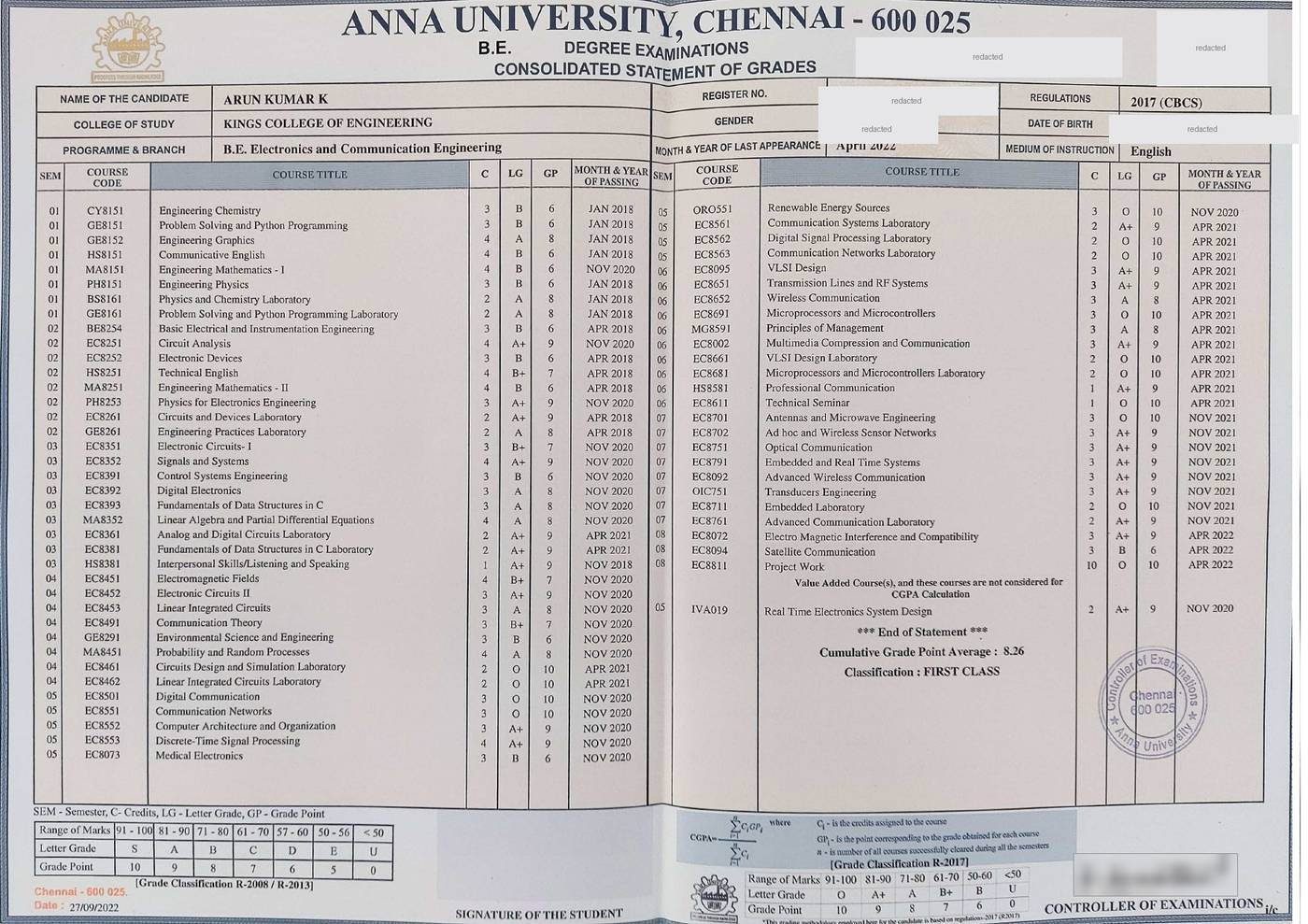
Anna University issues one consolidated statement of grades covering all eight semesters. Mine came out at a CGPA of 8.26 across the degree, classified First Class, with the last examinations sat in April 2022.
The full statement runs to about sixty courses. These are the ones that actually feed the work on this site - data structures, microcontrollers, embedded and real-time systems, computer architecture and networks.
| Code | Course | Credits | Grade | GP |
|---|---|---|---|---|
EC8393 | Fundamentals of Data Structures in C | 3 | A | 8 |
EC8381 | Fundamentals of Data Structures in C Laboratory | 2 | A+ | 9 |
EC8691 | Microprocessors and Microcontrollers | 3 | O | 10 |
EC8681 | Microprocessors and Microcontrollers Laboratory | 2 | O | 10 |
EC8791 | Embedded and Real Time Systems | 3 | A+ | 9 |
EC8711 | Embedded Laboratory | 2 | O | 10 |
EC8552 | Computer Architecture and Organization | 3 | A+ | 9 |
EC8551 | Communication Networks | 3 | O | 10 |
EC8563 | Communication Networks Laboratory | 2 | O | 10 |
EC8392 | Digital Electronics | 3 | A | 8 |
EC8095 | VLSI Design | 3 | A+ | 9 |
EC8661 | VLSI Design Laboratory | 2 | O | 10 |
EC8811 | Project Work | 10 | O | 10 |
Grading scale under regulations R-2017: O = 10, A+ = 9, A = 8, B+ = 7, B = 6, U = fail.
The degree did not make me a systems programmer. That came later, and mostly from writing code that had to survive a machine. But it decided the direction. Four years of being told what the hardware is actually doing underneath is why I reach for a measurement before a rewrite, and why allocation behaviour is the first place I look when a latency tail shows up.